What Is a Safe At-Home Balance-Training Plan to Reduce Fall Risk?
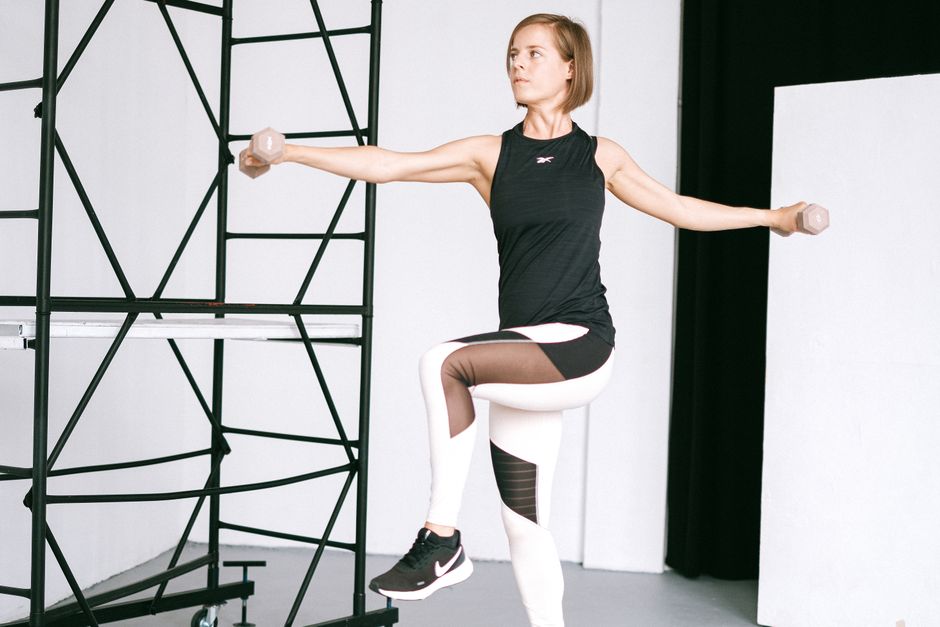
A safe at-home balance plan begins with supported weight shifts and chair rises, then progresses to walking and one-leg drills only when steady support is nearby. The National Institute on Aging recommends about three balance sessions each week, while persistent dizziness, recent falls, or sudden balance changes call for clinical assessment rather than a tougher home routine.
This is not a niche concern. In 2024, more than 14 million U.S. adults age 65 and older, or one in four, reported a fall, according to the Centers for Disease Control and Prevention. A home routine can be useful, but it is one controllable part of a larger fall-risk picture.
What exercises improve balance at home?
The most practical home balance exercises are supported weight shifts, sit-to-stand practice, heel-to-toe walking, balance walking, walking backward or sideways, and standing on one foot when support is close by. These are examples identified in the National Institute on Aging's 2025 exercise guidance, not a contest to see how little support someone can use.
Start where the movement is calm and repeatable. A chair or counter is useful because it makes the setup less dramatic: support is there before it is needed, rather than after a wobble. The NIA advises moving slowly and mindfully and keeping a sturdy chair, wall, or person nearby.
| Stage | Exercise focus | What makes it a sensible starting point |
|---|---|---|
| Supported standing | Weight shifts from side to side or forward and back while holding a counter | It lets the person explore controlled movement with immediate support available. |
| Everyday transitions | Sit-to-stand practice from a sturdy chair | The NIA includes chair-rise practice among balance examples and connects strength work with easier chair rises. |
| Walking control | Heel-to-toe walking, balance walking, or careful sideways walking near a wall or counter | These drills add movement without requiring unstable equipment. |
| Higher challenge | Standing on one foot or walking backward with support nearby | The NIA lists both as balance exercises, but the setup matters more than bravado. |
That sequence is an evidence-informed way to organize the NIA examples. It does not establish that every person should reach the final stage. A movement that produces grabbing, dizziness, or loss of control is not a useful progression.
The home itself is part of the routine. The NIA's balance-problem guidance recommends nonskid, rubber-soled, low-heeled footwear and cautions against walking in the dark or in smooth-soled slippers or socks. A correctly fitted cane or walker may also be needed for some people. Those details are plain, but plain is often what keeps a routine usable.
Why is my balance worse on one leg than the other?
One-leg balance may be worse on one side because balance is not just a leg-strength test; it depends on several body systems, and the supplied public sources do not identify a single cause for a left-right difference. The National Institute on Aging lists inner-ear conditions, vision problems, nerve problems, diabetes, heart disease, stroke, thyroid disorders, alcohol, and some medicines among possible contributors to balance trouble.
That list explains why guessing from one exercise is a poor diagnostic method. A weaker-looking side does not prove an ankle, hip, core, or vision problem, and the supplied research does not provide a safe self-test to sort those causes out. It does support taking new or persistent changes seriously.
According to the NIA, dizziness or vertigo, falling or feeling likely to fall, staggering while walking, lightheadedness, blurred vision, confusion, nausea, and changes in heart rate or blood pressure are symptoms that warrant attention. For a person managing possible worsening heart-failure symptoms, new lightheadedness or changes in heart rate are especially reasons to seek clinical guidance rather than treating balance drills as the full answer.
Some balance disorders respond to exercises involving particular head and body movements, but the NIA says those patient-specific exercises should be developed by a physical therapist or another professional who understands balance systems. The practical takeaway is refreshingly unglamorous: use support for general training, and seek assessment when the pattern is new, persistent, or accompanied by other symptoms.
How often should I do balance exercises to see improvement?
About three balance sessions a week is the National Institute on Aging's 2025 recommendation, and a consistent schedule is more defensible than sporadic heroic sessions. The evidence does not offer a guaranteed personal timeline for improvement, because participants, exercise programs, supervision, and underlying health conditions differ.
The broader evidence favors regular home exercise. A Community Preventive Services Task Force and CDC review found sufficient evidence that home-based exercise interventions for adults age 65 and older improve strength, power, muscular endurance, and balance. The reviewed programs used specific exercises, initial instruction with limited or periodic supervision, and sessions at least twice weekly, often using low-cost household resources such as chairs.
More is not automatically better. In that review, programs with more than three weekly sessions had larger balance effects than programs with three or fewer sessions, but the result describes reviewed programs, not a universal prescription. Safety, symptoms, supervision, and the ability to keep the routine controlled all change the right plan.
Strength belongs in the weekly picture too. The NIA's 2025 guidance recommends muscle-strengthening activity at least two days each week and states that one set of 8 to 12 repetitions can be effective, while two or three sets may be more effective. The source links that work with physical function, including getting out of a chair and climbing stairs.
How to progress without turning the living room into an obstacle course
Progress by changing one variable at a time: less hand pressure on support, a more deliberate walking drill, or a more demanding stance. Do not stack challenges simply because an exercise now feels familiar. A chair, wall, and clear floor are boring equipment. They are also enough to support the home-based approaches reviewed by the Task Force and CDC.
There is a meaningful reason to take the process seriously. In a 2023 BMC Geriatrics network meta-analysis of 66 randomized controlled trials involving 47,420 participants with a mean age of 77 years, home-based postural-control training had a fall risk ratio of 0.66 compared with control. In plain English, participants in that category experienced fewer falls than the comparison groups; it is not a promise that a particular routine will prevent a particular person's fall.
The same 2023 analysis concluded that physical activity including balance training was the most effective exercise approach for fall prevention among community-dwelling older adults. That is encouraging evidence, not a reason to ignore medication effects, vision changes, or symptoms that need medical review. The CDC identifies poor strength and balance and medicines that increase fall risk as modifiable targets for screening and intervention.
A practical conclusion: make the routine repeatable
The useful home plan is the one that can be repeated calmly: supported standing first, transition and walking drills next, and one-leg work only when the environment and control allow it. The NIA's 2025 framework provides the exercise menu; the Task Force and CDC review supports home-based programs that use simple household resources.
If balance trouble is persistent or changing, the NIA recommends discussing safe exercise and fall-risk reduction with a doctor. Keep the chair or counter close, keep the floor clear, and make consistency the process goal.
Frequently Asked Questions
Should I hold onto a chair while doing balance exercises?
Yes, a sturdy chair, wall, or another person can provide support during balance practice. The National Institute on Aging's 2025 guidance specifically recommends keeping support nearby and moving slowly and mindfully. Reducing hand contact can be a later progression only when the movement remains controlled and a qualified clinician has not advised otherwise.
Can strength training improve my balance?
Strength training can support balance and physical function. The National Institute on Aging's 2025 guidance states that muscle-strengthening activity at least two days each week helps make chair rises and stair climbing easier and helps prevent falls and fall-related injuries. It is not a substitute for balance practice, but the evidence supports combining the two.
What should I do if I feel dizzy or unsteady during balance training?
Stop the exercise and use available support rather than trying to push through the symptom. The National Institute on Aging explains that dizziness, vertigo, staggering, blurred vision, nausea, and changes in heart rate or blood pressure can accompany balance problems and merit discussion with a doctor. Persistent dizziness may require an individualized plan from a vestibular rehabilitation therapist or another qualified professional.
Sources
- National Institute on Aging: Three Types of Exercise Can Improve Your Health and Physical Ability
- National Institute on Aging: Older Adults and Balance Problems
- Centers for Disease Control and Prevention: Older Adult Falls Data
- Community Preventive Services Task Force and CDC: Home-Based Exercise Interventions for Adults Aged 65 Years and Older
- BMC Geriatrics: Exercise interventions and falls among community-dwelling older adults
Disclaimer: This article is for general information only and is not medical advice. It is not a substitute for diagnosis or treatment by a qualified healthcare professional. Always speak to your doctor before acting on anything you read here.